I consider Sony’s handling of the Spider-Man movies, and the property as a whole, to be a hit-or-miss endeavor. While they have produced some of the best in the franchise with the Tobey Maguire-led movies, especially the first two entries in the trilogy, Sony has ultimately proven that they are pretty much clueless when it comes to one of their major money-makers. Their questionable decisions (a Spider-Man villainverse, really?) and numerous reboots in recent memory have not given me much confidence, until only lately when they finally decided to let Kevin Feige and the rest of Marvel Studios take the reins.
And then, out of nowhere, here comes Spider-Man: Into the Spider-Verse, a film that I could argue is possibly a meta-commentary on the number of people to have portrayed the character in Sony’s films. So far, we’ve had three actors take on the role in just a span of six movies (within their own self-contained universes). However, it would be unfair to lump Spider-Man: Into the Spider-Verse together with the aforementioned movies, because directors Bob Persichetti, Peter Ramsey, and Rodney Rothman have created something very special here – a Spider-Man movie that feels genuine and full of heart but still deconstructs the character in a way that both fans and non-fans alike can appreciate.
It’s a rare thing when a big entertainment conglomerate allows its creators to have the creative freedom to do what they want, and I have to commend Sony Pictures for that. Into the Spider-Verse is produced by the duo Phil Lord and Christopher Miller, the same guys who did The Lego Movie and 21 Jump Street, with Lord co-writing the screenplay with Rothman. With movie credits like those, it’s really no surprise to see the film flawlessly land the relentless humor and optimistic energy that’s been missing in Sony’s previous Spider-Man movies.
One thing that obviously stands out this time is the creative choice they went for this film: going the animated route. This allowed the filmmakers to create a unique aesthetic for the movie, integrating comic book elements like narration boxes and thought bubbles. It’s a visual treat seeing onomatopoeias accompany every thwip! of Spider-Man’s web-swinging (which they’ve effectively utilized in a scene). Into the Spider-Verse is not just a straight-up CG movie like the countless Disney/Pixar films we’ve become accustomed to every year. The film has a style of its own, a big spectacle of sparkling imagery that breathes and shifts with the story, making it a feast for the eyes unlike anything that’s come before.

This stylistic choice is also in tune with our introduction to the main character, Miles Morales (Shameik Moore), a Brooklyn kid with a passion for street art. Miles, like any other Spider-Man origin story, gets bitten by radioactive spider while making graffiti in an underground subway station with his uncle Aaron (Mahershala Ali). Sounds familiar, doesn’t it? He then witnesses Spider-Man fall to the hands of the Kingpin, who attempts to open a portal to the multiverse to bring a parallel version of his family back to his dimension. Of course, not everything goes well, as the portal sucks in several alternate versions of Spider-men and women to his world too. Now it’s up to them, and Miles, to stop Kingpin (Liev Schreiber) and bring each one of them back to their respective homes.
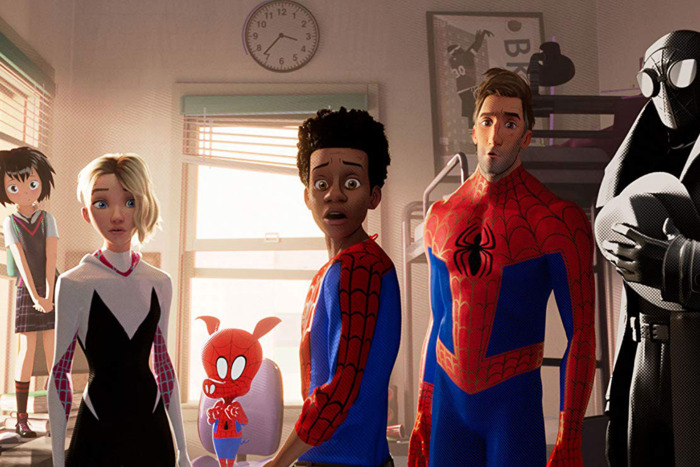
The multiverse plot point introduces several narrations from the respective point-of-views of the spider-people, whose similar origin stories are executed well enough that it doesn’t feel like a chore to get through. Accompanying Miles are Peter B. Parker (Jake Johnson), an older, depressed, out-of-shape Spider-Man who takes on a mentor role, Spider-Gwen (Hailee Steinfeld), Spider-Man Noir (Nicolas Cage), Peni Parker (Kimiko Glenn), and the weird but delightful Peter Porker, the Spectacular Spider-Ham (John Mulaney). So while they’re all Spider-people, each one is their own character with unique quirks and nuisance. In addition, and it’s all thanks to animation, each one of them has an aesthetic of their own, as they’re all drawn and rendered differently (Spider-Man Noir aptly appears in black and white, and can’t see color literally). This wild collision of style and colors from a whole spectrum of Spider-people feels like eating ice cream and candy for breakfast, and it’s never tasted so good.
But for all its visual romp, what Into the Spider-Verse ultimately proves is something that I’ve already known since I started reading comics, the one characteristic that makes Spider-Man one of my favorite superheroes of all time. Superhero comic books allows us to have an avenue for escapism. These characters aren’t real, but that doesn’t mean it can’t inspire us to be better. As showcased in this film, Spider-Man remains to be the most relatable hero of all, and that is the most influential aspect of the character. Even with all the several alternate versions of him, there’s one glaring thing that’s common – Spider-Man, at the character’s core, is an everyman, an ordinary person facing daily struggles like all of us, but somehow still has this genuine commitment to do what’s right, to help other people even at great cost.
Spider-Man: Into the Spider-Verse tells us that anyone can be Spider-Man. And pretty much almost everyone is in this movie.
Rating: ★★★★½
 The Talking Screen