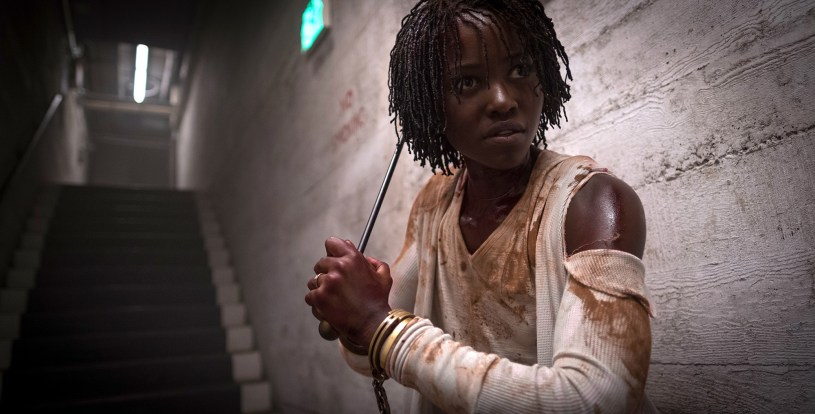
It is kind of hard to believe that it was two years ago when director Jordan Peele gutted everyone with the unsettling ingenuity and racial commentary of the Oscar-winning horror flick Get Out, a film that has only received more love and appreciation as time went along. And for his follow-up, Us, Peele goes for a more traditional set-up, utilizing various common horror elements that invoke some of the classics in the genre. As imaginative and well-crafted as it is, still, it does not live up to the brilliance of Peele’s directorial debut. I will admit that I went into Us blind; I haven’t seen any trailers for the film, nor read any descriptions or synopsis. My only expectations purely stemmed from the reputation of Get Out and Peele himself, whose name is already on the fast-track to becoming one of the great modern horror directors.
The film’s opening sequence is an instant nightmare classic, and perfectly lays the groundwork for what to expect of the rest of the movie. It’s 1986, and a little girl (Madison Curry) is on a seemingly fun night-out with her family on a beachside amusement park in Santa Cruz. While her father is distracted on a game of Whac-a-Mole (which he’s terrible at), the little girl wanders off and eventually ends up in a house of mirrors with a sign that reads “Find Yourself,” and she does literally. It’s a set piece that can easily resort to cheap jumpscares, and Peele even tries one at the start for fun. But it’s a misdirection to something much more disturbing and real that, for now, we only get a tight shot of the little girl’s horrific reaction.
Fast forward to the present time, the little girl, Adelaine Wilson (Lupita Nyong’o), now has a well-off family on her own. They’re on their way to their beach house in Santa Cruz for a vacation, much to the apprehension of Adelaine, as the events of that traumatic night in the fun house in 1986 still haunt her to this day. Her adorable goofy husband Gabe (Winston Duke) thinks this vacation would be a good activity for the family. He is outrageously bourgeois and the main source of the film’s humor, a complete contrast to Adelaide’s reluctant character who’s seemingly unable to let go a childhood trauma. Completing the family are their two children: daughter Zora (Shahadi Wright Joseph) and son Jason (Evan Alex), both typical movie children from the surface at the start, but their personalities only start to come out as the story moves along.
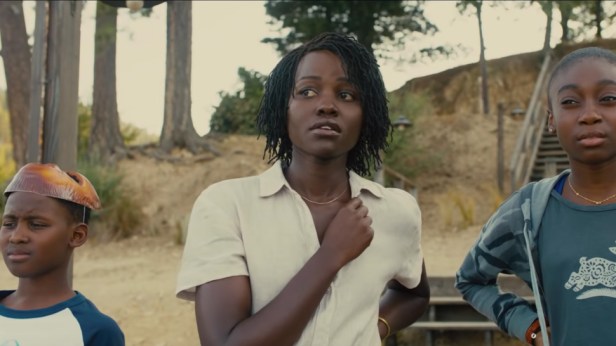
We finally get a taste of the bizarre when Jason sees an odd man, seemingly in a trance, at the beach with blood dripping from his gloved hand. But the real fun begins when they finally head back to their beach house that night, and encounter a strange family, all dressed in red jumpsuits and carrying pairs of golden scissors, standing still at their driveway. It takes some time for the strange family to reveal themselves. As it turns out, they’re vengeful doppelgängers of the Wilson family — twisted, corrupted mirror images of themselves. “It’s us,” Jason says. Aside from Adelaide’s double (named Red), the rest of the doubles lack any form of personality. Red’s the only one who can barely speak and communicate after all.
Each actor in the family seems to be having fun effectively playing two characters, but it’s Lupita Nyong’o that particularly stands out from the rest. She’s invested in hers, flawlessly drawing distinctions between her two selves. As Red, her movements are strict and trained, her voice a struggle between creepy howls and stutters. Adelaide, on the other hand, is more homey and human but still curiously hesitant, as if she’s desperately hiding something. Lupita Nyong’o tackles on her two roles extremely well, giving a powerful performance that gets more extraordinary as the stakes heighten. It’s notably interesting how this is her first leading role, after appearing in several supporting parts in Non-Stop, The Jungle Book, and Black Panther, and even winning an Oscar for Best Supporting Actress in 12 Years a Slave.
A major part of Us plays out like a home invasion movie, with the vile twist that the invaders are depraved versions of each of the family members. There’s a whole lot more mind-boggling surprises to digest further, as things get more complicated along the way. Peele saves all the backstory in an exposition-heavy final act. They’re all juicy reveals, but effectively too late. It’s a stream of revealing information that can be too much to take in especially in your first viewing. It’s a more straightforward approach to horror, albeit typical, elevated only by the help of masterful crafting and presentation. Peele and his cinematographer, Mike Gioulakis, work their magic all throughout, showcasing their natural understanding of creating tension and suspense through their shots and simple camera movements.
Us is a multifaceted movie that you have see again (and probably again) to fully appreciate it. It’s littered with easter eggs and foreshadowing, and its layers only unveil themselves once you have the full knowledge of what you’re getting into. Several scenes, incorporated with a lot of duplicity in the dialogue and visual metaphors, start to have a different perspective and meaning. Just like Get Out, Peele set out to say something to the world with Us. Is the underlying message the huge disparity between social classes — how the underclass, left to fend off for themselves, are depraved of even the most basic of needs? It’s open to multiple interpretations, and that’s Peele’s ingenuity.
Rating: ★★★½
 The Talking Screen