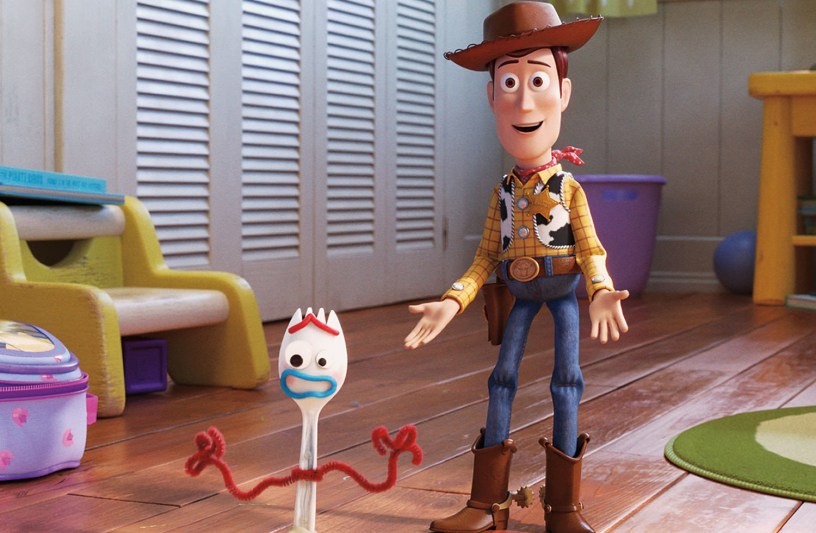
I remember feeling a nostalgic sense of closure when the credits hit in Toy Story 3. Andy’s gone to college and finally grew out of his toys, and Woody, Buzz and the whole gang is handed off to a new kid named Bonnie. The trilogy told a complete, satisfying set of stories about the life cycle of toys. And in a way, Woody is a representation of a whole generation that grew up with these movies, as we got to witness Andy’s whole childhood and him moving on.
This is it, Andy’s story is over. But for his toys, the adventure continues. So where does it go from here?
After finishing a trilogy worth of stories, especially one that has brought an emotionally devastating end, the franchise must take things to a new direction simply just to avoid treading the same old ground. And that’s what screenwriters Andrew Stanton (who co-wrote the first three films) and Stephany Folsom successfully did with Toy Story 4. This time, it finally explores the essence of what really qualifies as a toy, and some of the existential aspects that surround it.
At the centerpiece of it all is Bonnie’s creation named Forky (Tony Hale), a plastic spork that’s outfitted with googly eyes, broken popsicle sticks for feet, and pipe cleaners as arms. At first, Forky only says the word “trash”, which is all he wants and where he really belongs. This self-awareness stems from the fact that he’s made from dispensed materials, but somehow became sentient after being given humanoid characteristics and a name. For our hero Woody (Tom Hanks), seeing the joy Forky brings to Bonnie is good enough, and he’s made it his mission to prevent him from throwing himself into garbage and protect him at all costs. However, they find themselves separated from the rest of the group during Bonnie’s family trip to an amusement park, and soon end up in an antique shop presided over by Gabby Gabby (Christina Hendricks), a talking doll with a broken voice box who is constantly accompanied by creepy ventriloquist dolls as her henchmen.

The film’s caper-inspired plot and action is well-known among its established fans. But what makes Toy Story 4 still very much refreshingly compelling, even if it’s the fourth entry in the franchise, is that it bravely explores new territory in its themes and characters. It’s a movie that breaks out of the cozy structure that’s present in the three films, and Pixar films as a whole. Aside from the introduction of Forky and the deeper analysis of a toy’s existentialism, Toy Story 4 questions nature of the symbiotic relationship of a toy and its owner through the reintroduction of Bo Peep (Annie Potts). That’s the core concept that carried the whole franchise so far, and it’s pretty much Woody’s motivations as a character, but Bo Peep is now an advocate of living an independent life free from a kid or any type of owner after being given away years ago.
Furthermore, Toy Story 4 is a beautiful rollercoaster of emotions, where at any given moment it might deliver a laugh, a tender feeling, or even a jump scare (yes, there’s a few). There’s a surprise waiting around every corner, inciting a wide range of emotional reactions from its audience. This sense of perplexity is a welcome surprise especially for a studio that usually churns out carefully structured work most of the time. Nonetheless, it’s a Pixar film. And tears are eventually going to be shed at some point.
I have to commend director Josh Cooley and the screenwriters for breaking the mold while still being inclusive. Just when I thought Toy Story 3 is the perfect goodbye to the franchise, Toy Story 4 even tops it off to deliver a more heartwarming end. Whether you’re a newcomer to the series, or one that’s been with the gang from the start like me, it’s an emotionally rewarding film for each and everyone of us.
Rating: ★★★★½
 The Talking Screen