
Looking at Ad Astra at surface level will lead you to believe that it’s another space-set movie, about humanity’s great exploration into the vast frontier. Well yes, it’s easy to fall into that hole as it ticks all the visual tropes about the genre. One of the things I love about movies set in space is seeing the breathtaking shots of our solar system and space exploration – the planets, stars, rockets, all combined to showcase the captivating vastness of our universe. Ad Astra, the latest film from director James Gray, has all of the visual eye candy (and some action) you’d want in a space opera, but ultimately, it’s more of a character study of human isolation and relationships.
Ad Astra takes place in the near future, where humanity has colonized, and thus commercialized, the moon and continuously explores the outer reaches of our solar system. The film introduces us immediately to Major Roy McBride (Brad Pitt) as he does one of his regular psychological evaluations before going into his morning work in the International Space Antenna, a colossal structure extending into the Earth’s upper atmosphere. A sudden power surge causes him to free fall down to the ground, but he remains calm, his heart rate surprisingly remaining at 80. Later, he’s called in by the US Space Command’s (or Space Comm) top brass to reveal that the surges are actually anti-matter pulses caused by the Lima Project, a classified mission headed by his legendary astronaut father H. Clifford McBride (Tommy Lee Jones) to search other intelligent life some 16 years ago. Missing ever since, Space Comm believes that Clifford McBride might still be alive, and sends Roy on a top-secret mission to travel to Mars, as the reception is much better there, and communicate with his father.
We quickly learn, through flashbacks and in a way, in his psych evals, that Roy McBride has pushed his emotions so deep that his relationships have fallen apart. His wife (played by a criminally underused Liv Tyler) has left him, and now he’s very much alone. Be it as a result of his demanding military career or his missing father, he’s always running away from relationships and his own feelings. McBride’s taciturn nature is helped by his tired, monochromatic narration throughout the film, where we learn much of what he’s thinking and outlook of the world. It’s a great role for Pitt, who’s having a great year so far with Once Upon a Time in Hollywood, and now this. He’s proven time and again that he can kill it with any character. Even though some other scene-stealers appear, namely Ruth Negga and the brief appearance of Donald Sutherland, Ad Astra is all Brad Pitt.
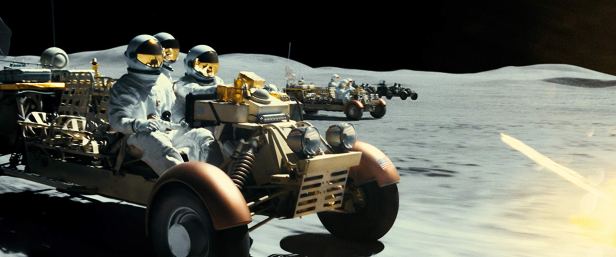
James Gray, with co-writer Ethan Gross, has built an immense, fully-realized world grounded in the realm of possibility. The world-building is subtle; much of the setting is simply shown through well-crafted shots. Roy’s journey journey to the moon has him taking a commercial flight – he gets charge $125 for a blanket and pillow – and arriving in an airport-like terminal complete with a Subway and Applebee’s, proving that we can’t escape capitalism even after all we’ve achieved. It’s also in the moon where we see one of many amazing and innovative setpieces, which is also a personal favorite of mine, in this film: a moonbuggy chase across the craters with space pirates.
There’s a lot more things Ad Astra has done right. The cinematography is beautiful and almost perfect, thanks to Hoyte van Hoytema (who also did Interstellar). His frames are seductively melancholic, evoking a beautiful sadness in the contrast of tiny spaceships and monstrous planets, effectively making us feel along Roy’s state of detachment and longing. The story pacing is just right, and expositions are just naturally conveyed in ordinary conversation. However, its character-driven drama is what sets it apart from other space-set stories. It doesn’t probe deep into Roy’s psyche as much as Gray’s underappreciated The Lost City of Z has in following its protoganist’s personal expedition, and the father-son story’s relatability may differ from person to person. That said, Ad Astra‘s ultimately humanist message is a bullseye. We’re really all we’ve got, and it communicates it with adult sophistication.
Rating: ★★★★☆
 The Talking Screen