
I have a particular fascination with the Southern Gothic subgenre. The flawed, disturbed characters finding their way into sinister events in the American South make for a captivating story that can only be told in those special trappings. Needless to say, life in these stories can be head-on bleak and full of misery. Whether it’s the choices they make or a string of unlucky experiences, bad things happen to everyone. But some people just seem to have all the bad luck in the world, and sometimes fate plays a cruel part in connecting them all together. This rings true in Antonio Campos’ The Devil All the Time, an adaptation of Donald Ray Pollock’s novel of the same name, where violence and despair is a dark cloud relentlessly hovering over the film’s cast of characters. No one is up to any good here, and sadly, we never got a chance to go any deeper than that.
Set in the heartland of post-WWII America, the story dives into the worst of humanity, exploring evil as a force that grips the lives of different families in various ways, that even men of faith fail to escape. Entrenched in the middle of it all is the Russell family, beginning with Willard (Bill Skarsgard) as he comes home to Coal Creek, West Virginia, suffering from PTSD after seeing a fellow soldier crucified by the Japanese forces in the Pacific front lines. The trauma shocked his religious faith to the core, as the simple image of a cross reminds him of that experience. He then marries Charlotte (Haley Bennett) and they settle down in Knockemstiff, Ohio. Having a family brings his faith back, albeit with a warped sensibility, twisting it as much as he can for his own personal gain when his wife is dying of cancer. A series of misfortunes eventually force their son Arvin (Tom Holland) to live with his grandmother and stepsister (Eliza Scanlen), who suffers from her own tormented history which involves her mother Helen (Mia Wasikowska) and delusional preacher father (Harry Melling).
Arvin is the closest we get to having a lead protagonist, given the fact that he’s the most developed character throughout. But The Devil All the Time features a sprawling ensemble cast who fights for as much screen time as they can over a duration just above two hours. The same day Willard and Charlotte meet, we are also introduced to the meeting of Carl (Jason Clarke) and Sandy (Riley Keough), the latter being the sister of corrupt county sheriff Lee Bodecker (Sebastian Stan). The couple goes on to become psychopathic serial killers victimizing male hitchhikers to satisfy their weird kinks. And at the cruel hands of fate, these group of characters’ lives will soon unknowingly converge together.
Got all that? Screenwriters Campos and his brother Paulo tried their best to make a coherent story out of all the plot threads presented. And with all the seemingly connected storylines introduced, a lot of them unfortunately end up underdeveloped and fall by the wayside. Every scene and character carries enough narrative relevance to merit further exploration, but Campos feels the need to move the pace along because there’s much more story to cover. The artistic choice to include narration (done by Pollock himself) circumvents some of the usual characterization with exposition, but it ends up ruining the dramatic journey for some. It’s a classic case of a movie telling rather than showing. Perhaps if we were allowed to immerse ourselves in their misery a bit more, these characters would feel real and very much alive.
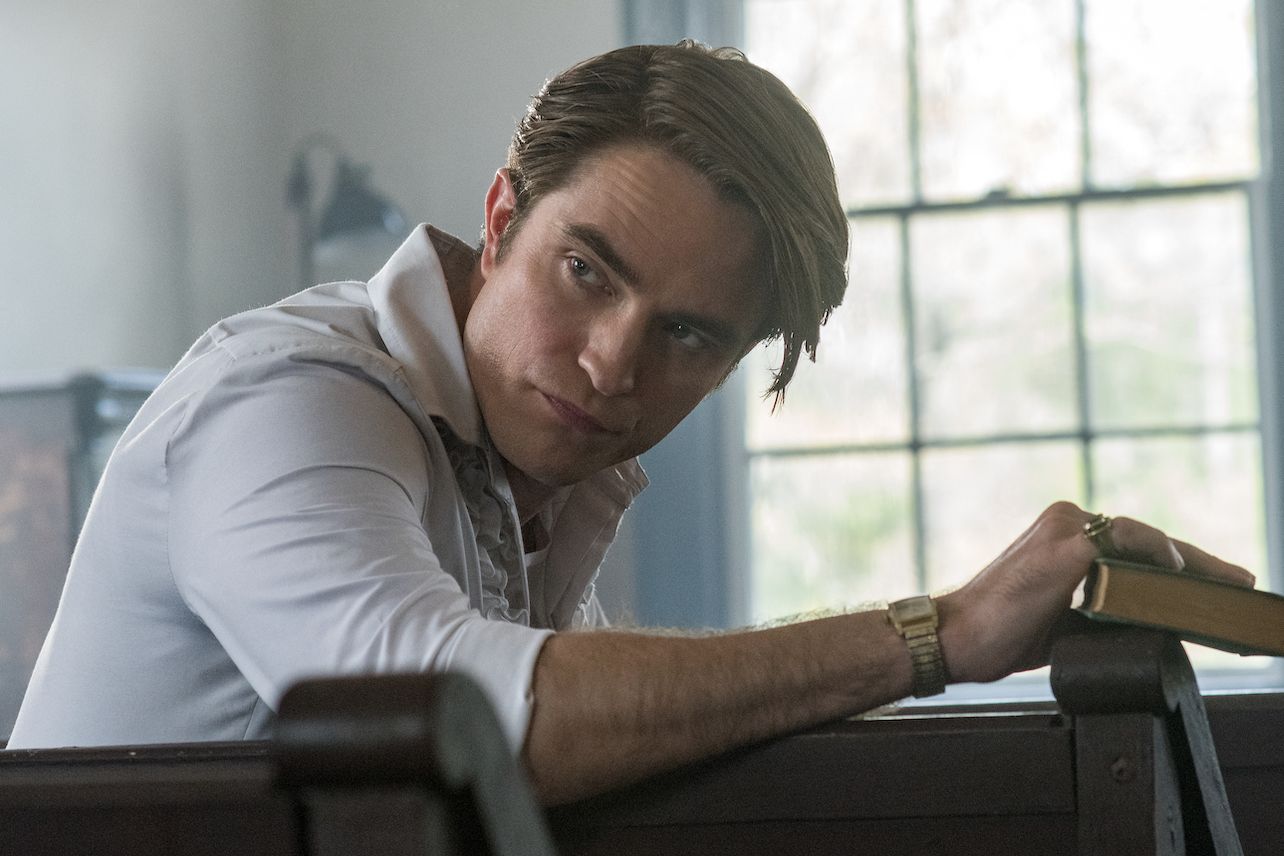
Despite some of the drama not hitting their marks, the largely non-American cast does a superb job of portraying Southern wrongdoers with what they’re given. Mia Wasikowska, Haley Bennett, Harry Melling, and Bill Skarsgard give exceptional performances, albeit wasted. But the best of the bunch is Tom Holland, who shows his range and proves he can be a serious actor when he wants to be. And Robert Pattinson‘s introduction as Rev. Preston Teagardin kicks the film to another level. Pattinson’s performance may appear to be campy, especially compared to the rest of the cast. But he plays the part of an odious preacher so well that he comes off as completely revolting, capturing religious hypocrisy perfectly even with an amusing nasally accent.
There’s still a lot of things to like about The Devil All the Time, and I found myself breezing through the two hour runtime. Campos has made a well-crafted film and it shows. The period production design is top notch, every scene portrays the gothic aesthetic beautifully, and the choice of using film cameras really adds to the grittiness of the story its telling. For all its flaws, its willingness to dive into the dark, twisted violence of the country is enough to keep my attention. Still, I can’t help but think this would’ve worked better as a mini-series, and then we can really see how vile these characters are.
Rating: ★★★☆☆
The Devil All the Time is streaming now on Netflix.
 The Talking Screen