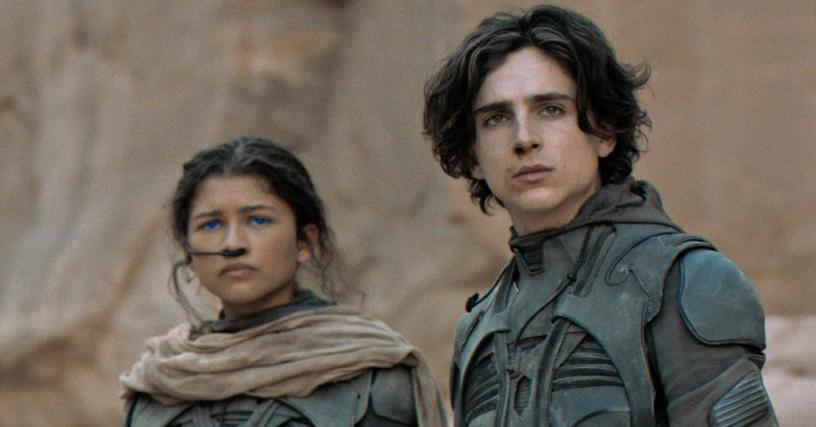
The one property science fiction fans have been clamoring for a proper big screen adaptation for years now is Frank Herbert’s 1965 novel Dune. It’s been done before, of course, with David Lynch’s 1984 adaptation, which turned out to be an unstructured mess that’s better left forgotten. With a book as dense as Dune, cramming its entirety into a two-hour movie is simply setting up for failure. That’s why Denis Villenueve, along with co-writers Jon Spaihts and Eric Roth, only takes less than half of Herbert’s novel, allowing more room to breathe and build its vast galaxies right. The result is a colossal spectacle that, by the time it ends, will only leave you clamoring for more.
Set in the far distant future, the premise follows the imperial Atreides family after Duke Leto Atreides (Oscar Isaac) has been ordered to govern Arrakis, a water-deprived desert planet constantly mined for an essential mineral called spice – similar to how crude oil is mined in our world. Although aware that it’s some sort of power play by the Emperor, Duke Leto accepts the role and brings his family along. Arrakis’ previous masters, House Harkonnen, ruled by oppression, but the Duke plans to form a working relationship with its indigenous people the Fremen. His son, Paul (Timothee Chalamet), is a messiah-like figure with the potential to harness great power and bring glory to House Atreides. He is closely guarded by his mother Jessica (Rebecca Ferguson), who is a member of a witch order called the Bene Gesserit.
To Dune fans, all this information seem basic, and newcomers may find it hard to follow along as all these terms can sound very much like gibberish. The scope is galactic in scale alright, and there’s a ton of ground to cover just around its lore alone. But for the most part, the script does a great job of communicating important information without feeling like an overwhelming exposition dump. It also helps that Villenueve decided to only adapt what seems like a third of the book – even billing the film as Dune: Part One in the opening – to set up proper world building.
Needless to say, adapting the dense novel is a massive undertaking with its rich universe and characters. Villenueve successfully keeps that grandeur very much alive in Dune. It’s safe to say that I’ve been a fan of his body of work. He’s one of the few filmmakers who can imagine captivating set pieces that turn into thrilling experiences, which can be very much expected after his venture into sci-fi genre – his previous film Blade Runner 2049 is another ambitious reinvention of a beloved property. Working with master technicians like cinematographer Greig Fraser and composer Hans Zimmer, the director delivers well-crafted colossal spectacles like city-size ships descending down the desert, ornithopters flying through a wild sandstorm, and a sandworm devouring a mining tank with its teeth-laden maw that’s the stuff of nightmares. Dune is filled with these immersive sensory bursts that vibrates through the screen. A marvel of sound design and cinematic images.
The spectacles have enough strength to carry the film on its own, but the ensemble cast and relationships of its characters add emotional weight on top of everything. Although it certainly feels like a lot of them are archetypes, the central Atreides family is the core of Dune, having almost all of the emotional focus as they navigate their way through their newfound roles in Arrakis. Paul is the reluctant “chosen one” that sees his position as more of a burden than a gift. “You made me into this freak,” he shouts in one scene to the horror of his mother. Rebecca Ferguson is that star of the film, however. Her performance is enigmatic, jumping from domineering to fragile with ease, as she nurtures his son to fulfill his role of a mythical superbeing.
Denis Villenueve has emphasized time and time again that Dune is a film to be experienced in the cinema, and I tend to agree. The film is colossal in scale that’s clearly meant to be seen on a big screen. Not once did it feel like a slug even with its two-and-a-half hour runtime. Its biggest flaw to me, however, is just as when you’re deeply hooked into it, the movie abruptly ends. Like a pilot episode to a TV series, Chani (Zendaya) cheekily mentions that this is only the beginning to Paul Atreides (which also works as a *wink* moment to audiences). With Villenueve finally giving us a taste of his vision for Dune, let’s just hope Warner Bros. allows him to fulfill the tale.
Rating: ★★★★½
 The Talking Screen