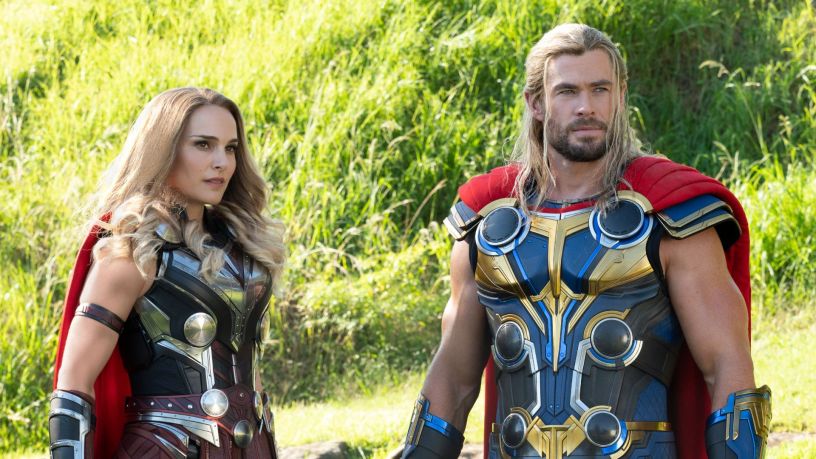
After the huge success of Thor: Ragnarok, it’s no surprise that the executives at Marvel Studios greenlit a followup with the same director at the helm. Taika Waititi added his own personal stamp to a multimillion dollar franchise film (which doesn’t happen so often) and breathed new life into the character, giving him some form of personality to stand with the rest of the Avengers. The humor were all hits, and it perfectly blended all the comedy with the more serious moments. That’s why it’s disappointing to see that Thor: Love and Thunder, now also co-written by Waititi, is such a tone-clashing mess of a movie that it’s surprising how it manages to tie everything together by the end.
Three years after Avengers: Endgame, Thor (Chris Hemsworth) has been hanging out with the Guardians of the Galaxy, but still feels without a true purpose after losing every one of his loved one over the course of several Marvel entries. Meanwhile, a terminally-ill Jane Foster (Natalie Portman), who we’ve last seen in 2013’s Thor: The Dark World, returns and becomes the Mighty Thor herself, wielding the broken Mjolnir from the previous film. The two meet again after almost a decade, both using hammers as weapons and doing superhero stuff.
The newest addition, and by far the most extraordinary of them all, is Gorr the God Butcher (Christian Bale). Wearing monk-like robes and covered in scars, Gorr is a wraith of vengeance who wields the Necrosword, a mystical weapon for killing gods. He plans to end all deities regardless of the faith and civilizations they belong to. And his reason? Gods have become far too self-indulgent and complacent, leaving their people to starve to death instead of helping them.
Bale’s performance stands out among the rest of the cast. He gives Gorr an old-school villain feel, switching between serious and sympathetic, relishing every chance to be as contrasting as he can against our titular hero. Part Pennywise the Clown and part Voldemort, he is a delight to watch – even though he ends up being criminally underused in the film – who provides a stark contrast to Chris Hemsworth’s fun-loving Thor. For a god butcher, he doesn’t really live up to his chosen moniker.
The movie has a lot of plot points to juggle, and Marvel usually handles this mix and match quite well – introducing new and returning characters, developing the main arc of its protagonist, all the while keeping the momentum going for the next installment in the franchise. The pacing feels very rushed as well. It’s been reported that the original version of Thor: Love and Thunder is more than two hours long, and it’s obvious that a lot has been cut from the final theatrical version. There are a lot of heartwarming moments that the film touches on, but does not really delve into. Instead, this jarring tone shifts undermine its own sincere situations with out of place jokes, removing any emotional weight around them.
Perhaps Waititi’s far too jokey dialogue, which absolutely works in his other films like What We Do in the Shadows, is a detriment to the story he’s trying to tell here. The return of a major character in Natalie Portman’s Jane Foster should be a big deal, but her character is unfortunately lost among all the rubble around her, robbing her major development of any real triumph. Thor: Love and Thunder may have brought Thor a purpose again in an aimless post-Endgame MCU, but it did so in a manner that doesn’t particularly earned. It’s all thunder, but lacks heft.
Rating: ★★½
 The Talking Screen