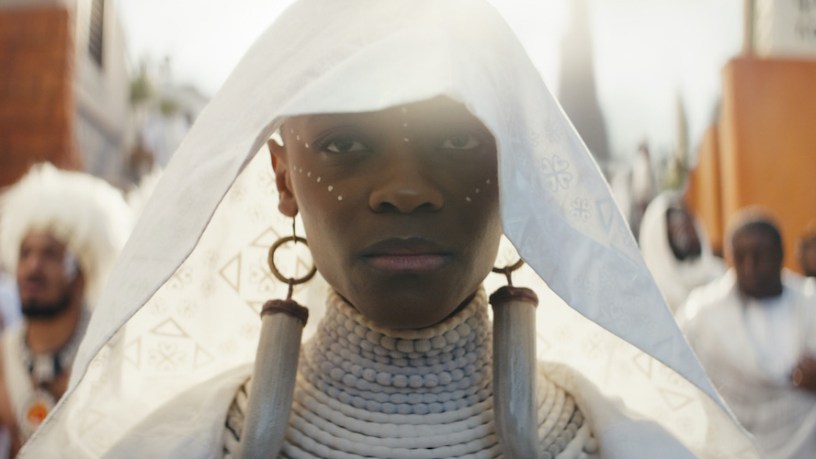
Right from the get go Ryan Coogler and Marvel Studios had the near impossible endeavor of living up to, let alone surpassing, 2018’s Black Panther, a phenomenal hit and landmark of representation in pop culture. Expectations are already rightfully high for the sequel, even before Chadwick Boseman’s tragic death in 2020. Coogler opens the film with a funeral for King T’Challa. Garbed in white traditional clothing, Queen Ramonda (Angela Bassett) and Shuri (Letitia Wright) follow a black coffin on the streets of Wakanda against a backdrop of dancers celebrating the life of its fallen king. Now Black Panther: Wakanda Forever, at its core, is a sincere and worthy memorial to its late hero, but it still constantly reminds us that it’s a Marvel movie, which means there are prerequisites that need to be checked for the franchise machine.
Like most of the movies within the Marvel Cinematic Universe, the script suffers from juggling multiple narrative requirements: allowing its characters to grieve the loss of T’Challa, passing the torch to a new Black Panther, and introducing a new Marvel character. In this case, it’s Riri Williams (Dominique Thorne) who gets to have her own Disney+ series Ironheart in the works. After T’Challa opened Wakanda’s doors to the world, superpower nations now want their own share of vibranium, and they’re going to take it whether through treaties or illegal means. Using a vibranium-detecting machine developed by Williams, a CIA expedition mining for underwater deposits is killed when they’re attacked by blue-skinned superhumans that can breathe underwater led by Namor (Tenoch Huerta). This leads to Shuri and Okoye contacting Everett Ross (Martin Freeman) for information about the incident, which then leads to more unnecessary subplots that disrupt the narrative flow of the film.
With a two-and-a-half hour runtime, Wakanda Forever is both better and worse for it. The movie has so much stuff going on that it needs the added screentime, but ultimately fails in utilizing it effectively. Various narrative threads feel contrived, and the movie grinds to a halt for exposition just as when things are gaining momentum. This stop-and-go approach to its storytelling further drags down the overall viewing experience for a plot that already feels overblown, thanks to the inclusion of Riri Williams and CIA subplots that only serve to set-up spinoff material. What made Black Panther work is it mostly stood on its own. It rarely concerned itself with callbacks or cameos to the greater MCU continuity, and only focused on worldbuilding and telling a cohesive story.
The better, more exciting parts of the film are given to its antagonist, Namor, the pointy-eared, winged feet ruler of the underwater city of Talokan. Coogler and his co-writer Joe Robert Cole positions the Talokan people as indigenous Mayans who settled in the depths of the Atlantic ocean to escape from the Spanish colonization (probably to separate them from being compared to Aquaman’s Atlanteans, even though they have similar origins in the comics). Like Killmonger before him, he is one of the better developed villains in the MCU with an understandable motivation. His primary goal is the protection of his nation and its people from the surface world’s colonist nations, tackling the same geopolitics themes present in Black Panther. He later uses this reason to issue a threat masquerading as an alliance with Wakanda.
A scene-stealer in every way, Wakanda Forever is filled with both charm and tension whenever Namor is on screen. He radiates a commanding presence it’s hard not to think he’s the centerpiece of the movie, and Huerta’s somehow manages to demand respect for a character with fluttering wings on his feet. Angela Bassett gives a powerful regal performance as Queen Ramonda that rivals Namor’s. Her voice roars from a scowl that pierces through every scene. No doubt both of them are the most positive aspects of the film. On the other hand, Letitia Wright struggles against an unwieldy script that desperately needs a key hero. The rest of the supporting cast like Winston Duke and the underused Lupita Nyong’o (who only appears much later) are also relegated to smaller roles.
The issues would have been easier to tolerate if not for the lack of striking visuals of the original film. The heavy reliance of Marvel, and Disney in general, on using the Volume as its main shooting philosophy is starting to hurt their product. The Afrofuturist aesthetic that proudly displayed Wakandan culture are just blurry backgrounds this time. Colorful cinematography has turned into incomprehensible sludge. Even the Talokan nation only received the bare minimum of worldbuilding, with the misfortune of having its larger than life Mayan architecture drabbed in murky waters.
Before the film ends, another silent montage of Chadwick Boseman plays. Its heart is in the right place with several sincere moments from the cast, which also served as real life mourning for a fallen co-star. I don’t find the movie terrible at all surprisingly. There’s a decent movie in there despite its glaring flaws. But ultimately, Wakanda Forever feels like watching your favorite band without its frontman, like seeing the Rolling Stones without Mick Jagger. Sure, Keith Richards and the rest of the band still plays their hits really well, but there’s a palpable absence that you can’t ignore.
Rating: ★★★☆☆
 The Talking Screen