[Note: This post contains some spoilers for the pilot episode of The Last of Us.]
When an adaptation for the hit dystopian survival video game The Last of Us was announced, it’s safe to expect that fans of the game have some reservations. After all, most adaptations for video games turn out to be duds, due to the fact that a majority of them try to change the fundamental aspects of its source material. But you can put those worries to rest, as the premiere episode of HBO’s The Last of Us starring Pedro Pascal and Bella Ramsey is off to an incredible start, mixing just the right balance of horror, drama, and apocalyptic dread.
The series is headed by Craig Mazin (the Emmy-winning writer and creator of the critically acclaimed limited series Chernobyl) and Neil Druckmann (the writer and creative director of the video game it’s based on), so you couldn’t give this project to more capable hands. Both write the whole nine-part first season, and the pilot itself is directed by Mazin. While the show uses its first episode as a set-up for things to come, it doesn’t mean things didn’t already go down, because it certainly did. Mazin and Druckmann know how to make one hell of a opening hook.
The episode opens with a small prologue set on a talk show in 1968, where two scientists are being interviewed about what could possibly cause the next global pandemic. One of them thinks that whatever potential virus or bacteria emerges, humans would eventually overcome it. The other one, however, has a more grim outlook. He believes mind-controlling fungi could spread on a global scale, turning humans into mindless zombies. And with a continuously warming planet, it is only a matter of time until the fungi could thrive all the more – setting the stage for the main cause of the dystopian world we’ll see later on.
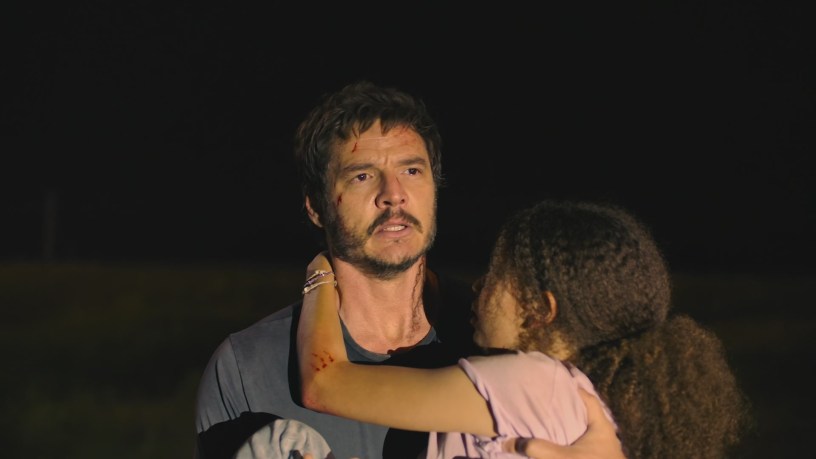
Jumping to 2003, the first half-hour of the show’s 80-minute premiere is set in Austin, Texas, where we meet single father Joel Miller (Pedro Pascal), his daughter Sarah (Nico Parker), and his brother Tommy (Gabriel Luna). It is Joel’s birthday, but unbeknownst to them, the Miller family would go on to have a harrowing day. This is where fans of the game would be presented with familiar scenes: by two in the morning, the world is going to hell. Helicopters flying over the skies, explosions in the distance, and people turning into monsters. As they try to escape the city, Tommy gets separated from Joel and Sarah amidst all the chaos. Joel and Sarah are confronted by a soldier, who gets orders to execute them. Joel begs him not to, saying that they’re not infected. The soldier guns them down anyway, but before he can finish off Joel, Tommy shoots the soldier in the head. Unfortunately, Sarah doesn’t survive the night.
Fast forward 20 years, the rest of the episode takes us to a quarantine zone in post-apocalyptic Boston, where Joel does odd jobs here and there. He does general cleanup work for a government militia called Federal Disaster Response Agency (FEDRA). On the side, he smuggles contraband with his business and romantic partner Tess (Anna Torv). The two are trying to scrape enough money to buy a battery and a truck so they can find and reunite with Tommy in the wild ruins of America. At this point, the infected have taken most of the world, their viciousness only rivaled by gangs and rebel groups. One of these rebels is the Fireflies, whose goal is to be free from FEDRA’s martial law. They are also holding a mysterious girl Ellie (Bella Ramsey), a teen that seems to be immune from infection. Marlene, the leader of the Fireflies, knows her significance, but intends to keep it secret. When things go awry, Marlene ask Joel and Tess to take Ellie with them across town to another Fireflies squad. In return, Joel and Tess get all the ammo, supplies, and a car to find Tommy. And this is where the real story starts.
Mazin and Struckmann shy away from the heavy exposition used by the game. Instead, they drop hints of the outbreak that’s slowly occurring through various visual cues and subtle dialogue. The scene where the old lady twitches in the background is horrifying. Another example is news reports from the TV and radio about a “disturbance in Jakarta.” Most importantly, The Last of Us is not just about the infected monsters roaming around, but also an exploration of a post-apocalyptic society where humanity is sometimes a thing of the past. If this kind of quality continues, HBO has struck gold yet again.
 The Talking Screen