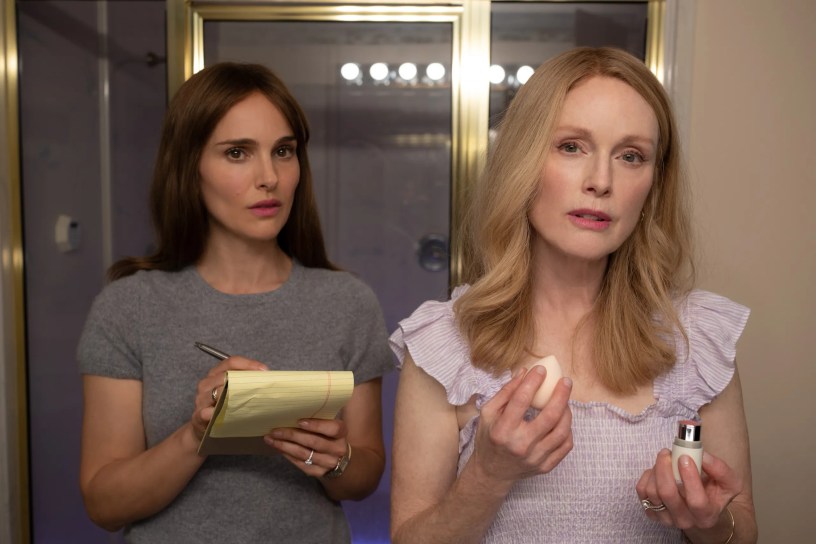
The biggest accomplishment of Todd Haynes‘ May December is its masterful ability in keeping you deeply entranced in its emotionally dissonant story, yet at the same time making you awkwardly uncomfortable. The director understands how sensitive (and weird) his film’s main subject is, and purposely leans heavily into it to evoke a wide variety of emotional responses from us. Are we supposed to find this funny? Maybe we should feel some pity? Or perhaps we should just let sleeping dogs lie and get on with our lives? One thing’s for sure: if the director feels something in particular, then so should we.
So what makes it all so unnerving? The film centers around a well-known television actress Elizabeth Berry (Natalie Portman) doing research for her latest role in an indie film. She arrives in Savannah, Georgia to study Gracie Atherton-Yoo (Julianne Moore) who, as a 36-year-old mother of two, was caught having an affair with a seventh grader back in the early ’90s. They became a tabloid sensation, and Gracie went to prison while being pregnant with their baby. Now more than two decades after the scandal broke, Gracie and her husband Joe Yoo (Charles Melton) are still together, living a seemingly quiet married life and moving past their dark history. They have three kids: two of which are set to graduate from high school in a few days. When asked why Elizabeth wants to play such a controversial role, she tells Gracie that she wants her to feel “seen.”
May December seem light on the surface, but underneath is a truly twisted drama. The film’s tonal identity shows up early on when Elizabeth walks into Gracie’s home during a family barbecue. A cascade of dramatic piano notes swoop in, a jarring melody you’d usually hear in cheesy soap operas when something horrible is about to happen. And when they finally meet for the first time, she gets struck by Gracie’s innocent demeanor. Haynes uses this cordial introduction, combined with a discordant piano score, to announce the ridiculous tone that will persist for the rest of the film. He gives similar mundane scenes the same treatment, adding in some creepily awkward humor to disjoint, or simply doing long takes with characters directly facing the camera, all to give the audience feeling of unease for the unsettling tale that’s unfolding.
Because at its core, this seemingly easygoing film is ultimately about the disconnect between the lies we tell ourselves and the lives we live. At one point in the film, Gracie assures Elizabeth that she is secure and that “insecure people are dangerous.” Of course, she’s convinced herself that she did nothing wrong, that they’re merely star-crossed lovers. Although Gracie appears composed in public (she and her husband playfully dismisses a mailed package with feces when Elizabeth first arrives), she’s often on the verge of breaking down in private when faced with any sort of reminder of her past. Her blithe personality has become a form of control in her own artificial reality. She’s a micromanaging mother completely indifferent that her passive-aggressive way of communicating with the people around her may be, in fact, abusive. May December is Todd Haynes and Julianne Moore’s fifth collaboration, and it’s one of Moore’s more nuanced performances.
She’s already a real piece of work, and yet Portman’s Elizabeth comes off surprisingly more unhinged. In her study of Gracie, Elizabeth mirrors her mannerisms, lisp, fashion sense, and even her make up. She’s going full method, believing that her exploitative presence in Gracie’s life, despite starting to cross boundaries, is justified in the name of research. When she visits the pet shop where Gracie and Joe first started their affair, she reenacts the time they were caught having sex in the back room. She starts off friendly enough, but then becomes submerged in Gracie’s identity. Everything about Elizabeth’s personality unravels when she’s invited to a high school drama class Q&A and talks about blurring the line between reality and fiction, admitting that she finds gratification in playing morally problematic characters. It’s a testament to Portman’s excellent performance, one that evolves throughout the film until we finally see who Elizabeth really is.
Meanwhile, Charles Melton’s Joe Yoo is a touching portrayal of a victimized boy that’s trapped in a 36-year-old body. A man of few words, he’s reserved and often lost in thought when not attending to his hobby of breeding butterflies (or his “bugs” as Gracie dismissively refers to them) with the goal of setting them free. He’s truly passionate about it, and one of the only few instances we see Joe ever truly himself. It’s an overt metaphor for his character, but one that I highly doubt Haynes even intended to be subtle in the first place. He’s has not fully evolved into a butterfly after all these years, stuck in a relationship that’s hindered his growth.
Loosely based on the real life case of Mary Kay Letourneau, Samy Burch’s screenplay touches on our unrelenting fascination with other’s misfortune. They are criticized or pitied, and eventually tossed aside when a new one comes along. May December is a disturbing look at how real-life traumas are used for mindless entertainment, resulting in the countless true crime shows and documentaries of varying quality that have found a home in streaming platforms (this film streaming on Netflix is probably a meta-commentary). As a final punchline, the film ends with a Tár-like sequence when Elizabeth is on set as Gracie, believing in her art and totally engrossed by her role in what ultimately appears to be a B-movie.
Rating:
 The Talking Screen