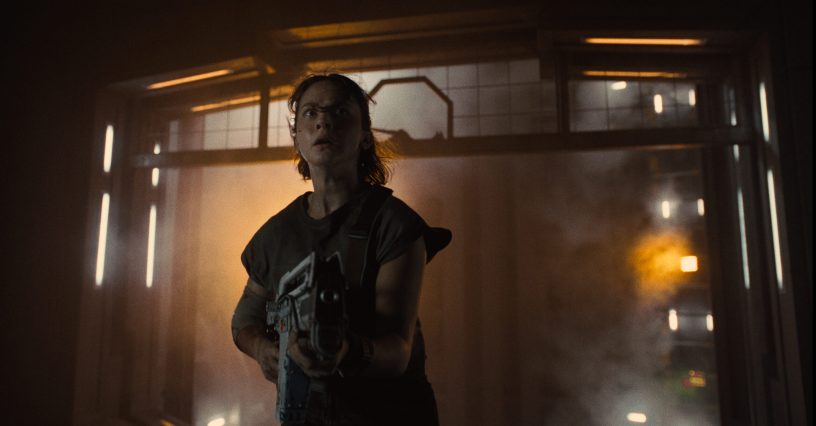
Fede Álvarez’s latest installment returns the Alien franchise back to its roots, moving away from the grandiose narrative introduced in the prequel films after a heavily divisive reception. The main criticisms of Prometheus and Alien: Covenant were that they were far more philosophical rather than incorporating the cosmic horror elements of the originals, essentially saying that they didn’t feel like Alien movies (and for the record, I liked Prometheus enough and appreciate its ambition, while Covenant feels like a step down). While Alien: Romulus feels like a rehash of Ridley Scott’s 1979 classic, Álvarez’s competent filmmaking makes this new entry fun and tense, even delivering some genuinely new frights and sequences for a 45-year old franchise.
Set after the events of Alien, the film mainly follows orphaned miner Rain Carradine (Cailee Spaeny) and her adoptive synthetic brother Andy (David Jonsson). After learning that her mining contract is forcibly extended by the Weyland-Yutani Corporation, she reluctantly joins her ex-boyfriend Tyler (Archie Renaux) and their friends to raid a decommissioned space station they’ve discovered hovering in orbit. They plan to salvage the ship’s cryostasis chambers, which would allow them to travel and wake up in the faraway planet of Yvaga. Kay (Isabela Merced), Bjorn (Spike Fearn) and Navarro (Aileen Wu) round up the rest of the crew and they, unfortunately, find out the hard way why the space station has been abandoned in the first place.
Adapting a more straightforward plot that’s similar in structure to the 1979 original, while moving away from the complex, existentially driven narratives of the prequels, feels like some sort of “reset.” This opens up Romulus to bring out slimy frightening sequences involving xenomorphs and facehuggers we have missed in previous entries. Fede Álvarez does a tremendous job at crafting memorable set pieces throughout the film, whether it’s the very first chestburster scene, the sprint across a hallway of facehuggers, or the insane climax of the film featuring an eerie abomination of a creature. One that stands out to me, however, is the zero gravity acid scene where Rain maneuvers through a corridor of floating alien acid blood. Álvarez has used gravity as a Chekhov’s gun since the beginning and seeing it brilliantly utilized in that way makes for a satisfying payoff.
Another aspect of the film that veered away from the prequels is the production design. While Prometheus and Covenant adapted a more modern state-of-the-art aesthetic in its set design, Álvarez goes back to the cassette futurism visuals of the originals, opting for bulky buttons and switches instead of the touchscreens and augment reality from the prequels. This adds to the already impressive world-building in Romulus. Almost everything looks and feels dirty here, and it honestly speaks to the proletarian nature that Weyland-Yutani has forced upon the setting and characters.
What people will most respond to, and what I think works best in the film, are the performances. Coming from career-defining roles in Priscilla and Civil War, Cailee Spaeny delivers a more physical performance here than before. Her portrayal of Rain as a reluctant heroine, but resolved in her will to survive, is the closest equivalent we’ve gotten to Sigourney Weaver’s Ripley. While Spaeny is formidable, it’s David Jonsson’s Andy that’s the a notable scene stealer. A synthetic whose prime directive is to protect Rain, Andy starts off as an innocent adoptive brother who makes dad jokes and changes to a stoic android once the crew arrive at the space station. He is the most interesting character in the film, and Jonsson shows off various emotions to great effect in every twist and turn of his character.
For all the good things Romulus has going for it, there’s one huge misstep that could’ve easily been avoided. Without spoiling too much, the crew reactivate the gooey, slimy remains of the space station’s synthetic science officer, Rook. His face has been digitally altered to look like a character from the first film. The janky CGI goes into uncanny valley territory that it kind of ruins the film a bit. Disney loves to use this tech, having utilized it for their other big IPs like Star Wars and Marvel. But this is the one case where it’s completely unnecessary for Rook to look like that particular character other than to serve as a callback and fan service, which this film already has a lot of.
So is doing a soft reboot the right choice for the franchise? Going by box office numbers, Alien: Romulus has already grossed a total of $229 million as of this writing, overwhelmingly surpassing its reported budget of $80 million. That’s clearly a win by Hollywood standards. So although Alien: Romulus keeps it on the safe side by going back to a tried formula, Álvarez’s excellent talents elevate the film into a solid entry. It’s diverting and entertaining enough to inject new blood and interest into the franchise, even if it severely lacks the narrative ambition of the recent films.
Rating:
 The Talking Screen