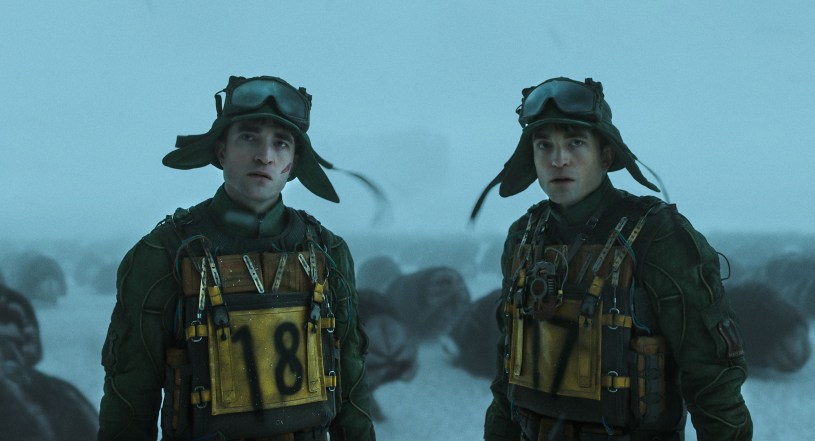
Mickey Barnes, the titular character in Bong Joon Ho’s latest film, lives a sad, grim life. He is an “Expendable” worker aboard a spaceship to colonize a faraway ice planet named Niflheim, and his only job is to be a human guinea pig for the sake of their settlement’s survival. That means he perishes over and over again in several grotesque ways, only to be reprinted in a new body with all his memories and personality intact. Mickey, played by Robert Pattinson, gets treated like garbage, repeatedly experimented on by being exposed to extreme conditions, injected with lethal viruses to create vaccines, and locked in a chamber pumped with toxic gas in the name of science.
The hapless Mickey has convinced himself that this bleak existence is punishment for a childhood accident, and figures that this is better than being on the run from a notorious loan shark back on Earth. This is all explained, by Mickey himself, in a prolonged sequence at the beginning. The darkly humorous montage of Mickey dying and being born again includes some of the film’s best scenes, and perfectly displays Bong’s fondness for adding comedic tones to the morbid. Perhaps the only positive aspects in Mickey’s life are Nasha (Naomi Acki), a security agent with whom he’s developed a loyal romance, and to a lesser extent, Timo (Steven Yeun), his friend from Earth.
During one particular dangerous mission, Mickey is tasked with capturing a “creeper” – the name given to Niflheim’s indigenous creatures – for research, but he accidentally collapses through a cave. Timo leaves him for dead in the snow since, as he justifies, Mickey is going to be reprinted anyway. And they do. Assuming the current iteration of Mickey (number 17) is dead, the scientists back at the lab prints out a new version of him, Mickey 18. So it becomes a serious violation of the colony’s law against multiples when Mickey 17 returns to the spaceship alive, and it’s up to the both of them to decide whether one has to be taken out of the picture, or coexist.
Mickey 17 is Bong’s third English-language film (following 2013’s Snowpiercer and 2017’s Okja), and his first major Hollywood-backed effort with a budget of almost $120 million. Featuring large-scale production design and a stacked cast, the budget definitely shows. The visual effects – the creepers in particular – are fantastic too.
Pattinson is undoubtedly the film’s best asset of Mickey 17. The character actor, whose post-Twilight career consists of playing oddball roles, gives strong distinct performances to both Mickeys. 17 is a naive, sweet-natured people pleaser, while 18 has a more hostile demeanor which often resorts to violence. Still, Pattinson’s delightful portrayal anchors the two down well enough that they don’t feel like two independent characters, despite both having opposite personalities. Pattinson has an air of wackiness to him, and that’s makes this so fun.
The bad guy here is Mark Ruffalo as the dim-witted, fascist politician Kenneth Marshall. Along with his wife Ylfa (Toni Collette), the couple sits on top of the food chain enjoying all luxuries off everybody else’s hard work. They ultimately intend to implement eugenic policies, filling Niflheim with people of “purity.” In other words, white. So it’s quite obvious that Marshall has similar qualities to a certain president. He has a catchy slogan and leads a group of loyal, almost cult-like followers that do his bidding. However, Bong has clarified that he is an exaggerated caricature of different politicians and authoritarians over the years, and a cartoonishly spunky Ruffalo plays him like one.
The South Korean auteur has always incorporated themes of extreme class divide, authoritarianism, and other social critiques in his filmography. This film explicitly tackles those issues as well, although not as subtle or polished compared to his previous projects. Whether intentional or not, Mickey 17 unfortunately feels universally more relevant than ever, especially with the rising popularity of conservatism and other right-wing ideologies today. But the fact that Mickey 17 ends on a more hopeful note may just be an indication of Bong’s belief that our society, even as dystopian as it could be, eventually finds a way to let our humanity prevail.
Rating:
 The Talking Screen