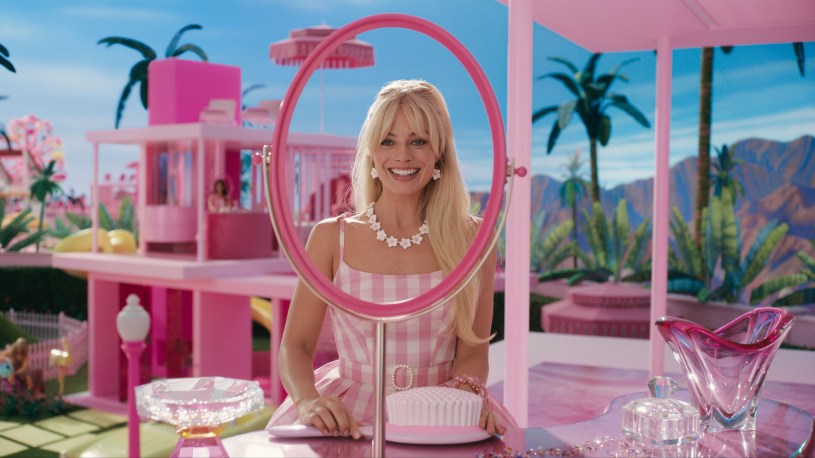
Barbie, writer-director Greta Gerwig‘s vibrant cinematic spectacle, has successfully breathed new life into one of Mattel’s most popular toy lines. The iconic fashion doll, which launched in 1959, is back in the current zeitgeist, painting the whole world pink once again thanks to Gerwig’s superb direction and a marketing campaign that’s one for the ages. It’s a hysterically funny and entertaining film that also manages to be a triumph of costume and production design, with incredible attention to detail and chock-full of pop culture references that one needs another screening to fully appreciate them.
One such reference is the opening homage to 2001: A Space Odyssey (a scene which you’ve probably seen multiple times in trailers) dubbed over by a narrator (Helen Mirren) telling the audience of the cultural impact of Barbie. It’s an aspiration envisioned by her creator Ruth Handler – a world where women don’t have to be stuck as mothers when they can be doctors, lawyers, scientists, or even a president. This rings true in a place called Barbieland, a utopia for women, a pink paradise where “all problems of feminism and equal rights have been solved” thanks to Barbie. Here, everything is perfect and everyone is Barbie (played by an ensemble cast including Emma Mackey, Alexandra Shipp, Issa Rae, and Hari Nef), and life is one long party.
But the party is suddenly put to a halt when Stereotypical Barbie, played by Margot Robbie in a role so perfectly cast that the narrator even makes a joke about it, asks aloud, “Do you you guys ever think about dying?” Faced with a sudden existential crisis, she seeks Weird Barbie (Kate McKinnon) and learns that a portal between Barbieland and the real world has been opened. Now Barbie must travel through to reality and save her owner from loneliness (the cause of her having thoughts of death), while at the same time discover her true purpose. Along for the ride is her “boyfriend” Ken (Ryan Gosling) because his whole existence is simply to be with Barbie. In the real world, both discover some harsh truths far from the utopian fantasy in Barbieland – Barbie’s physical appearance have set unrealistic body expectations in young girls, and society is actually ruled by men, or “the patriarchy.”
In addition to looking exactly like the part, Robbie portrays Barbie with earnest humor and sweet innocence, exhibiting the naive idealism of living in a candy-colored utopia. At the same time, she also handles the more emotional and serious moments later in the film after learning the reality of human society. It’s a flawless performance. Her co-star Ryan Gosling, however, is a certified scene-stealer. His himbo portrayal of Ken is the embodiment of physical comedy that him simply existing and doing nothing in a scene is enough to be knee-slapping hilarious. Gosling switches from slapstick behavior to deadpan machismo with minimal effort after promptly discovering that men are supposed to rule and ride horses.
With Gerwig and co-writer Noah Baumbach’s smartly written script that acknowledges the woes of women simply existing in society, it’s very apparent that the core message of the film is about feminism – and to be specific, commercialized feminism. Along with the Barbies and Kens, Will Ferrell plays the CEO of Mattel (the doll’s manufacturer) who insists that their company is very pro-women despite having an all-male executive board. It’s not at all surprising considering that Barbie is a line of dolls from a business empire after all, designed to inspire young girls and of course, make money (as the executives keep telling us). Gerwig incredibly finds the right balance of making the corporate overlords feel that they’re in on the jokes while ambitiously opening a conversation about the conundrum of womanhood. It’s the trappings of being part of corporate IPs.
Despite all that, Barbie never feels any less inclusive. It’s a highly enjoyable film for everyone as much as it is for female audiences with its feminist themes. Even I, a male, had a great time seeing this in the cinema. Gerwig and Robbie have made a dazzling achievement of deconstructing a beloved franchise while tackling modern issues in gender roles, even if it feels corporatized at times.
Rating:
 The Talking Screen
Robbie’s performance was pitch perfect, as you said. There was lots to enjoy in this film – in fact, I may have to see it again because I was so taken with the Barbieland set!
You made a great point about corporate overlords. Excellent review!
LikeLiked by 2 people
Thank you very much! It’s a really fun film overall.
LikeLiked by 1 person