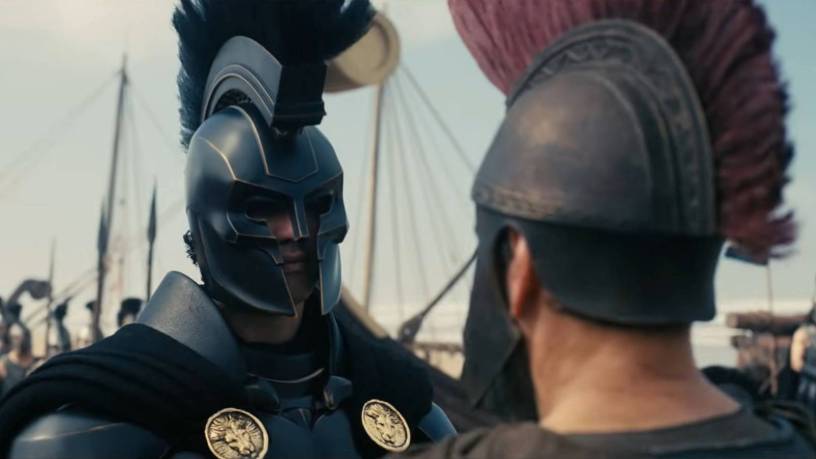
For a literary work as lasting as Homer’s The Odyssey, it’s hard to imagine how Hollywood had not properly made a big budget adaptation of it. That is until Christopher Nolan decided to do it himself. The result is a thrilling blockbuster of epic scale, successfully turning a 3000-year-old poem into a massive modern hit, and one that’s much better appreciated on the big screen, or the biggest of screens like an IMAX theater.
Nolan’s The Odyssey is far from the usual depiction of a hero’s glorious homecoming. On one hand, Odysseus (Matt Damon) is portrayed to be a brilliant strategist and well-respected by his men, and on the other, a complicated man haunted by the horrors of what he’s done, a familiar archetype in the auteur’s filmography. The king of Ithaca yearns to be back home with his wife Penelope (Anne Hathaway) and son Telemachus (Tom Holland), and yet is riddled with extreme guilt for violating Zeus’ Law, the ancient Greek moral code of hospitality, during the decade-long Trojan War. He believes that his actions may very well be the catalyst in the fall of their civilization.
As you’d expect from Nolan, much of what happens during Odysseus’ journey home is told in pieces and flashbacks, mostly through his own returning memories in his time stranded with Calypso (Charlize Theron). Nolan’s mathematical approach to storytelling pieces things together nicely by the end, and everything pays off perfectly when the film reveals the full events of Agamemnon (Benny Safdie) and Odysseus’ ransacking of Troy.
Another artistic decision from Nolan is the use of contemporary dialogue, which has been controversial ever since it was revealed in the trailers. But honestly, it’s hardly even noticeable after the first few minutes of the film. And I sincerely believe that having a more accessible dialogue, especially in adapting a story written in the 8th century B.C., is the right approach for modern audiences.
Cinematographer Hoyt van Hoytema’s visuals emphasize the tactility and grittiness of The Odyssey, which is also a testament to Nolan’s filmmaking and the film’s elaborate production design. The strict adherence to realism and practical effects allows the audience to be physically in tune with the set pieces. You can almost feel the scorching heat of a burning Troy, or the unforgiving waves of the ravaging seas. Even the more fantastical elements of the story feel very much grounded, relying on forced perspectives camerawork with minimal help from CGI. A favorite of mine is when Odysseus visits the underworld, and undead figures come rising out of the soil covered in mud. It’s a simple depiction, yet eerily more effective than literally entering to the fiery gates of hell.
Performances from the ensemble cast are all incredible. Damon’s portrayal of Odysseus should secure him at least an Academy nomination. Holland’s Telemachus is his best performance yet. Robert Pattinson, who plays one of Penelope’s suitor Antinous, is just so good at playing sleazy and weird characters.The witch Circe, played by Samantha Morton, transforms men into animals in a way that’s by far the scariest performance in the film.
Having almost a 3-hour long runtime, The Odyssey has a way of keeping you immersed and engaged. We learn of Odysseus’ faults and sins and yet still root for his successful homecoming to his family. This film is the perfect vessel for Nolan’s preoccupation with the complexities of humanity and moral reckoning that’s so apparent in his filmography. It’s both thoughtful and ambitious, and somehow magical in how it manages to be so relatable despite being a story that’s thousands of years old.
Rating:
 The Talking Screen
I can’t wait to see it in 70mm soon
LikeLiked by 2 people
It’s going to be a great experience. Enjoy!
LikeLike